How to Store MQTT Camera Frames and Binary Sensor Data with a Time Index

· 13 min read
Alexey Timin
Co-founder & CTO - Database & Systems Engineering

Storing MQTT data in ReductStore"

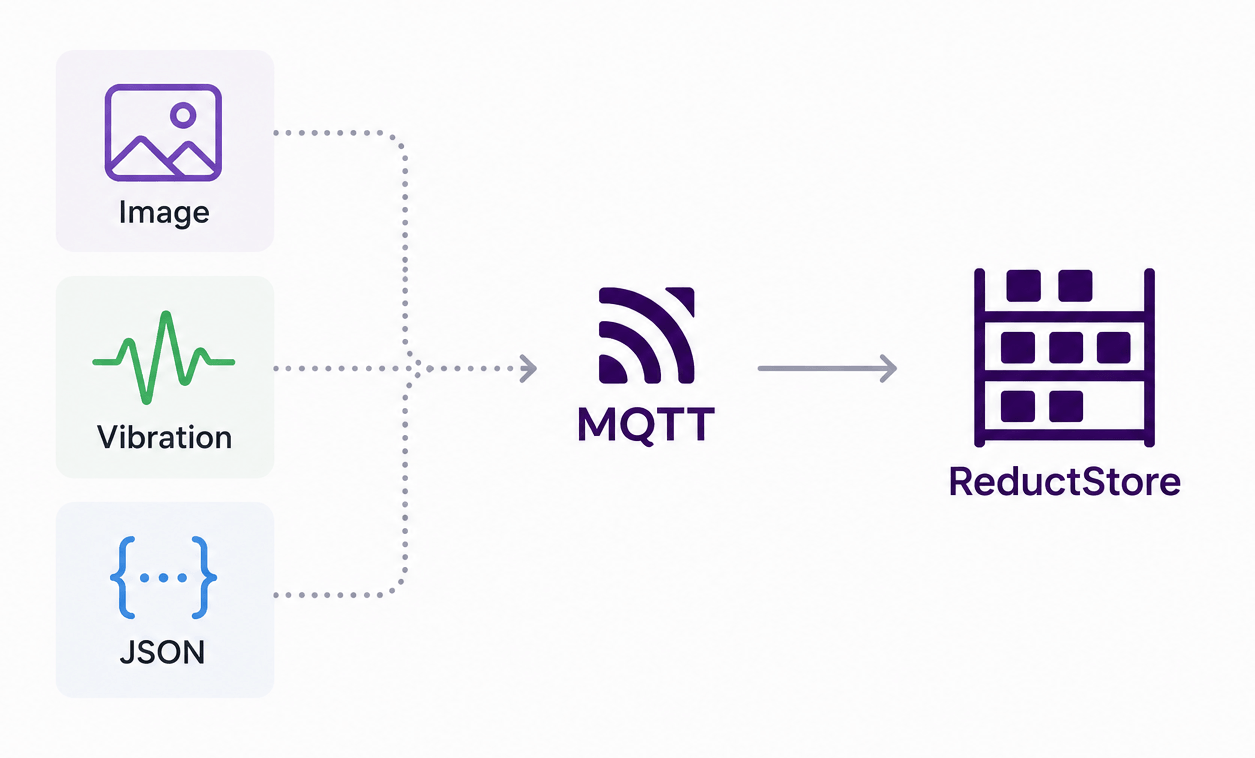
MQTT is a common choice for the communication stack in IoT and robotics applications because it is lightweight and easy to integrate. But many of those applications do not send only small JSON telemetry messages. They also publish JPEG frames, vibration waveforms, audio clips, protobuf messages, and other binary payloads that need to be stored and queried later.

This is where a regular MQTT broker or a traditional time-series database starts to fall short. Brokers are designed for message delivery, not long-term historical storage, and many databases either expect structured numeric fields or make it hard to keep large binary records tied to accurate timestamps.

In this tutorial, we will use ReductBridge to subscribe to MQTT topics and write the raw binary payloads into ReductStore with a time index. This lets you keep camera frames and sensor payloads as they are, while still querying them by time range, labels, and entry name for replay, debugging, and offline analysis.

CRA-Compliant Robotics Data Storage 2026: How to Solve the Data Storage Challenges of the CRA

· 5 min read
Leif-Birger Hundt
Building the data layer for scalable robotics & industrial AI

The CRA Deadline Every German Robot Operator Must Face

The EU Cyber Resilience Act (Regulation (EU) 2024/2847) is the “GDPR for connected products.” It entered into force on 10 December 2024, with critical milestones approaching fast:

  • 11 September 2026: Mandatory reporting of actively exploited vulnerabilities and severe incidents (24-hour early warning, 72-hour full notification).
  • 11 December 2027: Full compliance — Security by Design, lifecycle support (minimum 5 years), technical documentation, and CE marking.

For robotics fleets (AMRs, cobots, autonomous systems, and ROS 2-based platforms) the stakes are particularly high. These systems are “products with digital elements” (often Class II or critical), generating massive multimodal data streams (camera feeds, LiDAR, IMU, logs, ROS bags) under real production constraints: intermittent connectivity, edge hardware limits, and high physical safety risks.

Generic storage solutions force painful trade-offs: either accept data loss and compliance gaps, or accept exploding costs and slow performance. ReductStore eliminates this trade-off.

How to Store and Manage Robotics Data

· 12 min read
Gracija Nikolovska
Software Developer - C#, Python, ROS
Anthony Cavin
Co-founder & CEO - Data, ML & Robotics Systems

Introduction Diagram

Robots generate massive amounts of data, and managing it well is harder than it looks. Storage fills up fast, cloud transfer gets expensive, and real time ingestion is unforgiving when you're running cameras and sensors at high frequency.

This article covers practical strategies for handling robotic data, introduces ReductStore, and walks through a hands on example. Along the way, we cover native ROS integration, Grafana dashboards, MCAP export for Foxglove, a Zenoh API, and native S3 and Azure backends. We also compare ReductStore against Rosbag and MongoDB so you can pick the right tool for each part of your stack.